GSTR-2A vs GSTR-2B
Understanding the difference between GSTR-2A vs GSTR-2B is important for every GST-registered business that wants to claim Input Tax Credit (ITC) correctly. Both statements contain information about purchases and inward supplies reported by suppliers, but they work differently and serve different purposes.
Many businesses get confused when the figures in GSTR-2A and GSTR-2B do not match. Knowing how these statements are generated, when they are updated, and how they should be used can help businesses reduce ITC errors and improve GST compliance.
What is GSTR-2A?
GSTR-2A is an auto-drafted statement that provides details of inward supplies reported by a taxpayer’s suppliers. The information is based on invoices and other relevant documents uploaded by suppliers through their GST returns.
One important feature of GSTR-2A is that it is dynamic. This means the information can change whenever a supplier uploads, modifies, or files relevant invoice details.
For example, if a supplier uploads an invoice after you have already checked your GSTR-2A, that invoice may appear later. Similarly, amendments made by the supplier can change the information reflected in the statement.
Therefore, GSTR-2A can be useful for tracking supplier filings and identifying missing or incorrect invoices.
What is GSTR-2B?
GSTR-2B is an auto-drafted Input Tax Credit statement generated for a registered taxpayer. It provides information about the ITC available or not available based on the information furnished by suppliers and other relevant sources.
Unlike GSTR-2A, GSTR-2B is a static statement. The GST Portal generates it for a particular period, and the statement provides a fixed view of the relevant documents for that period. According to the GST Portal’s advisory, GSTR-2B is generally made available on the 14th day of the succeeding month for monthly taxpayers.
This makes GSTR-2B particularly useful when reconciling ITC before filing GSTR-3B.
GSTR-2A vs GSTR-2B: What is the Difference?
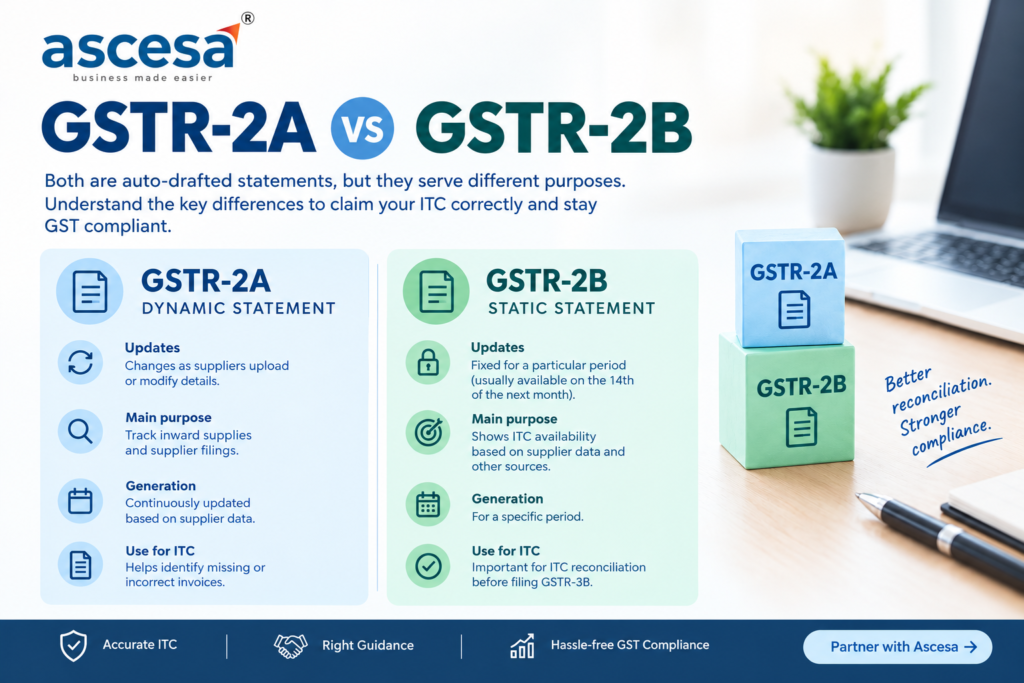
The main difference in GSTR-2A vs GSTR-2B is their nature and purpose.
| Particulars | GSTR-2A | GSTR-2B |
|---|---|---|
| Nature | Dynamic statement | Static statement |
| Main purpose | Track inward supplies | Determine ITC availability |
| Updates | Can change when supplier data changes | Provides a fixed statement for the relevant period |
| ITC reconciliation | Useful for tracking supplier invoices | Important for ITC reconciliation |
| Generation | Continuously updated based on supplier filings | Generated for a specific period |
| Use with GSTR-3B | Supporting reference | Important reference for ITC reporting |
The key point in GSTR-2A vs GSTR-2B is that GSTR-2A is primarily useful for monitoring supplier-reported transactions, whereas GSTR-2B provides a more structured statement for assessing ITC.
The GST Portal has also implemented system-based checks comparing ITC available in GSTR-2B with ITC claimed in GSTR-3B.
Why Can GSTR-2A and GSTR-2B Show Different Amounts?
Differences between the two statements can occur because they follow different reporting and timing mechanisms.
Some common reasons include:
- A supplier files or uploads an invoice after the relevant GSTR-2B cut-off.
- The supplier makes an amendment to an invoice.
- Credit notes or debit notes are reported in different periods.
- Supplier returns are filed late.
- Certain transactions are reflected based on specific system timelines.
- Import-related information may be included in GSTR-2B through the relevant systems.
For this reason, businesses should not assume that every difference between GSTR-2A and GSTR-2B represents an error.
Which Statement Should Businesses Use for ITC?
When considering GSTR-2A vs GSTR-2B for ITC reconciliation, businesses should give particular attention to GSTR-2B.
GSTR-2B provides information indicating the availability of ITC against documents reported by suppliers and other relevant sources. It is therefore an important document for reviewing ITC before filing GSTR-3B. The GST Portal has stated that eligible ITC is auto-populated into relevant portions of GSTR-3B based on GSTR-2B-related data.
However, businesses should not blindly claim every amount appearing in GSTR-2B. Other GST conditions and eligibility requirements must also be considered before claiming ITC.
How Businesses Can Reconcile GSTR-2A and GSTR-2B
A proper reconciliation process can help businesses identify missing invoices, incorrect GSTINs, duplicate entries and supplier filing issues.
A simple process is:
- Download the relevant GSTR-2A and GSTR-2B statements.
- Compare purchase records with GST statements.
- Identify invoices that are missing or mismatched.
- Check supplier filing status and invoice details.
- Review eligible and ineligible ITC separately.
- Follow up with suppliers where corrections are required.
- Reconcile the final figures before filing GSTR-3B.
Regular reconciliation is better than waiting until the end of the financial year because errors can become more difficult to trace later.
Common Mistakes Businesses Should Avoid
While understanding GSTR-2A vs GSTR-2B, businesses should avoid treating both statements as interchangeable.
Common mistakes include:
- Claiming ITC without checking eligibility.
- Ignoring differences between purchase books and GST statements.
- Not following up with suppliers for missing invoices.
- Assuming that an invoice appearing in a statement automatically makes the ITC eligible.
- Failing to reconcile ITC before filing GSTR-3B.
- Depending only on GSTR-2A for final ITC calculation.
A consistent reconciliation system can help businesses maintain accurate GST records and reduce the possibility of ITC-related issues.
Frequently Asked Questions
1. What is the main difference between GSTR-2A and GSTR-2B?
The main difference in GSTR-2A vs GSTR-2B is that GSTR-2A is dynamic and can change as suppliers update their filings, while GSTR-2B is a static statement generated for a specific period.
2. Is GSTR-2B important for claiming ITC?
Yes. GSTR-2B is an important reference for reviewing ITC available for a particular period. However, taxpayers should also verify whether the ITC satisfies all applicable GST conditions before claiming it.
3. Why is my GSTR-2A higher than GSTR-2B?
This can happen because GSTR-2A is dynamic and may include invoices or amendments that fall outside the relevant period or cut-off used for generating GSTR-2B. Differences should be reconciled rather than automatically treated as errors.
4. Should businesses reconcile GSTR-2A and GSTR-2B?
Yes. Reconciliation helps businesses identify missing invoices, mismatches, duplicate entries, supplier filing issues and potential ITC differences. Reviewing both statements can provide better visibility over purchase transactions and ITC.
5. Can I claim all ITC shown in GSTR-2B?
Not necessarily. The appearance of an amount in GSTR-2B does not by itself remove the need to check the applicable conditions for claiming ITC. Businesses should verify eligibility and reconcile the figures with their books and other GST records.
Conclusion
Understanding GSTR-2A vs GSTR-2B is essential for accurate GST compliance and effective ITC management. While GSTR-2A provides a dynamic view of supplier-reported inward supplies, GSTR-2B provides a static period-wise statement that is particularly important for ITC reconciliation.
Businesses should regularly compare their purchase records with GSTR-2A and GSTR-2B, identify mismatches, communicate with suppliers when corrections are needed, and verify ITC eligibility before filing GSTR-3B.
Proper reconciliation can help businesses reduce ITC errors, maintain cleaner GST records and avoid unnecessary compliance issues. If your business needs professional assistance with GST reconciliation, ITC verification or GST return filing, Ascesa Business Services can help you manage your GST compliance more effectively.