MCA Annual Filing 2026
The Ministry of Corporate Affairs (MCA) has announced important relief for companies completing their annual statutory filings for the financial year 2025–26. Under MCA Annual Filing 2026, eligible companies have additional time to submit specified forms through General Circular No. 05/2026 dated 24 October 2026, without paying additional fees within the revised deadlines.
This update is relevant to private limited companies, public limited companies, small companies, and other entities covered under the Companies Act, 2013. The revised timelines give businesses more time to complete their annual filing requirements while ensuring accurate financial records and statutory disclosures.
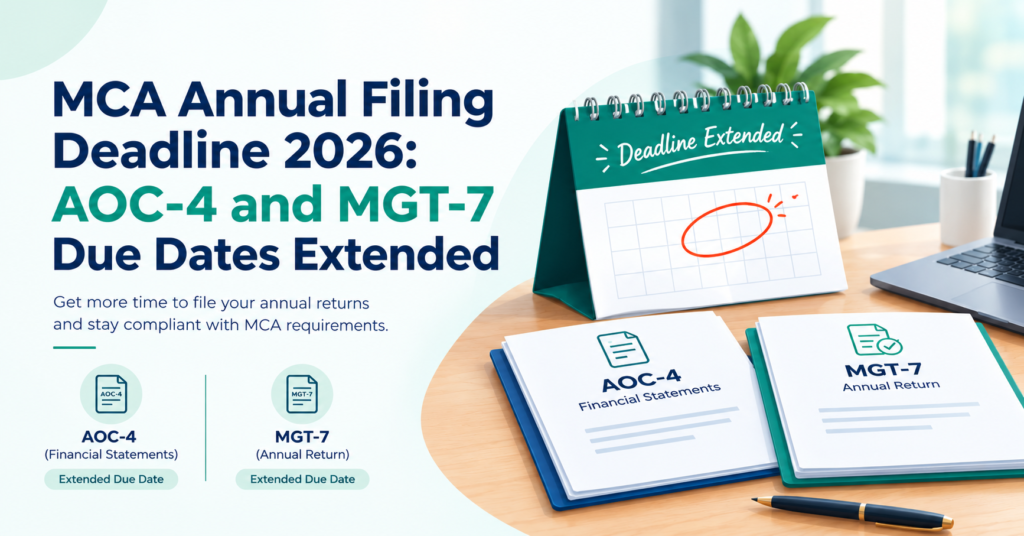
As per the announced extension, eligible companies can file the applicable AOC-4 forms by 31 December 2026 and MGT-7 or MGT-7A by 31 January 2027, without additional fees.
However, companies should note that this relief does not extend the statutory deadline for holding the Annual General Meeting (AGM). Businesses should plan their MCA Annual Filing 2026 process carefully, prepare the required documents, and complete their filings within the revised timelines to avoid additional costs and compliance issues.
What Is the MCA Annual Filing Deadline 2026 Update?
The Ministry of Corporate Affairs (MCA) issued General Circular No. 05/2026 following representations from stakeholders requesting additional time to complete annual statutory filings for the financial year 2025–26. This update brings important relief for companies preparing for MCA Annual Filing 2026, helping them complete their required compliance formalities within the revised deadlines.
The circular provides relief for two major categories of company compliance:
- Financial Statement Filing: Eligible companies can submit the applicable AOC-4 forms by 31 December 2026.
- Annual Return Filing: Eligible companies can submit MGT-7 and MGT-7A by 31 January 2027.
Under the revised timelines, eligible companies can complete these specified filings without paying additional fees, although normal filing fees, wherever applicable, must still be paid. This extension is an important consideration for businesses planning their MCA Annual Filing 2026 activities.
For companies managing multiple statutory requirements, the extension offers an opportunity to organise financial documents, verify company information, prepare annual returns and complete pending filings. Businesses should use this additional time to review their compliance records and ensure that the information submitted to the MCA is accurate and complete.
Companies should also understand that the extension does not automatically apply to every MCA form or statutory obligation. The relaxation specifically covers the forms and timelines mentioned in the circular. Therefore, businesses must check the applicable requirements before proceeding with MCA Annual Filing 2026.
It is equally important to remember that the extension does not extend the statutory deadline for holding the Annual General Meeting (AGM). Companies must continue to follow the applicable AGM requirements and plan their financial statement and annual return filings accordingly.
To avoid last-minute errors, companies can prepare their financial statements, board reports, auditor-related documents and annual return information well in advance. Professional assistance with MCA Annual Filing 2026 can help businesses understand the filing process, prepare the required documentation and submit the applicable forms within the revised deadlines.
By planning early and keeping track of the updated due dates, companies can manage MCA Annual Filing 2026 more efficiently, reduce the risk of filing delays and maintain better statutory compliance.identifies the forms covered by the relief, so other statutory forms must be handled according to their respective deadlines.
Revised ROC Annual Filing Due Dates for FY 2025–26
The following table summarises the important deadlines announced under MCA General Circular No. 05/2026.
| MCA Form | Purpose | Revised deadline without additional fees |
|---|---|---|
| AOC-4 | Filing financial statements | 31 December 2026 |
| AOC-4 (CFS) | Filing consolidated financial statements | 31 December 2026 |
| AOC-4 (XBRL) | Filing financial statements in XBRL format | 31 December 2026 |
| AOC-4 NBFC (Ind AS) | Financial statement filing for applicable NBFCs | 31 December 2026 |
| AOC-4 CFS NBFC (Ind AS) | Consolidated financial statements for applicable NBFCs | 31 December 2026 |
| MGT-7 | Filing annual returns | 31 January 2027 |
| MGT-7A | Filing annual returns by eligible companies | 31 January 2027 |
Important: These revised dates apply to the specified filings for FY 2025–26. Companies should confirm the correct form applicable to their category and circumstances before submitting documents.
1. AOC-4 Filing Due Date 2026: What Companies Need to Know
AOC-4 is used by companies to file their financial statements with the Registrar of Companies (ROC), in accordance with the Companies Act, 2013.
Financial statements provide an overview of a company’s financial position and performance during the financial year. They are important for regulatory compliance, financial transparency and maintaining proper corporate records.
Depending on the company’s structure and applicable requirements, the financial statement filing process may involve balance sheets, statements of profit and loss, cash flow statements, notes to accounts, the auditor’s report and other prescribed documents.
Under the latest MCA Annual Filing 2026 circular, the specified AOC-4 forms for FY 2025–26 can be filed up to 31 December 2026 without additional fees.
How should companies prepare for AOC-4 filing?
Businesses should take the following steps:
- Finalise the financial statements for FY 2025–26.
- Complete the applicable audit and obtain the necessary reports.
- Ensure the financial statements have received the required approvals.
- Verify company details and financial information before uploading the form.
- Check that attachments are complete and correctly prepared.
- Submit the relevant AOC-4 form through the MCA portal.
Errors in financial figures, missing attachments or incorrect disclosures may cause filing difficulties. Therefore, companies should review their documents before submission rather than waiting until the final deadline.
2. MGT-7 Filing Due Date 2027: Annual Return Compliance
MGT-7 is the prescribed annual return form used by companies to report information about their corporate structure and statutory details.
An annual return generally includes information relating to the company’s registered office, business activities, shareholding, members, directors and other prescribed particulars, as applicable.
Eligible companies that qualify for the simplified annual return form can use MGT-7A instead of MGT-7.
According to General Circular No. 05/2026, the revised deadline for filing MGT-7 and MGT-7A for FY 2025–26 is 31 January 2027 without additional fees.
What Should Be Checked Before MCA Annual Filing 2026?
Before completing MCA Annual Filing 2026, companies should carefully verify their annual return details and ensure that all information matches their official records. Accurate documentation helps businesses meet statutory requirements and reduce avoidable filing errors.
Companies should verify the following details before submitting their annual returns:
- Company Details: Check the company name, Corporate Identification Number (CIN), and registered office address.
- Directors and Key Managerial Personnel: Verify the details of directors and key managerial personnel, wherever applicable.
- Share Capital and Shareholding: Ensure that share capital details and shareholder information are accurate and up to date.
- Membership and Corporate Information: Review membership details and other prescribed corporate particulars.
- Relevant Dates and Supporting Documents: Confirm important dates and keep the necessary supporting records ready.
- Accuracy of Information: Cross-check all details entered in the applicable annual return form against the company’s records.
As part of MCA Annual Filing 2026, companies should ensure that their annual returns accurately reflect their actual corporate records and applicable statutory requirements. Any discrepancies between the information entered in the form and the supporting documents should be identified and resolved before submission.
Businesses should also confirm the applicable filing requirements and revised deadlines before proceeding with their annual returns. Proper preparation can help prevent delays and minimise compliance-related issues.
Professional assistance with MCA Annual Filing 2026 and annual return filing for a private limited company can help businesses organise documents, identify missing information, verify corporate details and complete the filing process more efficiently. By reviewing all information in advance, companies can maintain accurate compliance records and meet their statutory obligations within the applicable timelines.
3. Does the MCA Extension Mean Companies Can Delay Their AGM?
No. The circular does not extend the statutory time for holding an Annual General Meeting.
This is one of the most important points businesses must understand.
The MCA circular provides additional time for filing the specified financial statements and annual returns. It does not provide a general extension for holding the AGM under the Companies Act, 2013.
Companies must continue to comply with the applicable AGM requirements and statutory timelines. Where a company has failed to hold its AGM within the prescribed period, the extension of filing dates does not automatically remove that default or its consequences.
For this reason, businesses should review their AGM status separately from their AOC-4 and MGT-7 filing schedules.
If a company has missed its AGM deadline, it should obtain professional advice on the appropriate steps to address the non-compliance.
4. What Happens If a Company Misses the MCA Annual Filing 2026 Deadlines?
The extension announced for MCA Annual Filing 2026 provides companies with additional time to complete their annual statutory filings. However, businesses should not treat this relief as unlimited additional time, as missing the applicable filing deadlines may lead to additional compliance costs.
Paragraph 4 of General Circular No. 05/2026 clarifies that filings submitted after the period covered by the circular will attract applicable fees, including additional fees calculated from the original statutory due dates under the Companies Act, 2013.
Companies should therefore understand that additional fees may not necessarily begin only after 31 December 2026 for AOC-4 forms or 31 January 2027 for MGT-7 and MGT-7A. Businesses must review the circular’s conditions carefully before planning their MCA Annual Filing 2026 submissions.
Missing the applicable filing deadlines can increase compliance costs and may lead to further consequences under the Companies Act, 2013, depending on the circumstances. Timely completion of annual filings is essential for maintaining accurate corporate records and meeting statutory obligations.
To avoid delays and manage MCA Annual Filing 2026 efficiently, companies should take the following steps:
- Identify Pending Filings: Prepare a checklist of all outstanding annual compliance requirements.
- Confirm Filing Deadlines: Verify the original statutory due dates and the revised dates applicable under the MCA circular.
- Prepare Required Documents: Organise financial statements, annual return information and supporting records.
- Verify Forms and Attachments: Check all details in the applicable AOC-4, MGT-7 or MGT-7A forms before submission.
- Arrange Filing Fees: Pay the applicable normal filing fees and verify whether additional fees are payable.
- Maintain Filing Records: Save submission acknowledgements, filed forms and supporting documents for future reference.
Completing MCA Annual Filing 2026 well before the applicable deadlines gives companies sufficient time to resolve technical issues, arrange missing documents and correct errors. Early preparation also helps businesses manage their annual statutory compliance responsibilities more effectively.
Companies requiring professional assistance can consult experienced MCA filing service providers to help organise documents, understand filing requirements and complete their annual compliance process accurately and on time.rs.
5. Benefits of Timely Company Annual Compliance Filing
Annual compliance is not simply a regulatory formality. It helps companies maintain transparent records and demonstrate that they are meeting their applicable statutory obligations.
Better financial transparency
Filing financial statements helps maintain a formal record of a company’s financial position and performance. This information can support business reviews and other legitimate stakeholder requirements.
Improved corporate record management
Regularly completing annual returns and financial statements helps businesses maintain organised corporate records. Accurate records can also make future compliance tasks easier.
Reduced risk of additional costs
Using the revised deadlines under the MCA circular can help eligible companies avoid additional filing fees on the specified forms, provided the filings are completed within the permitted period.
Better compliance planning
A clear filing calendar helps directors, accountants and finance teams coordinate document preparation, approvals and submission.
Fewer last-minute errors
Starting early allows businesses to check details, prepare attachments and address inconsistencies before filing.
Companies should remember that meeting these deadlines does not automatically satisfy every compliance obligation. Other forms, tax filings and regulatory requirements may have separate due dates.
6. How Professional ROC Annual Filing Consultants Can Help
Managing annual filings can become challenging when businesses have incomplete records, multiple compliance requirements or limited internal resources.
Professional ROC annual filing consultants can assist with reviewing documentation, identifying the relevant forms and coordinating the filing process.
Support may include:
- Reviewing company records and annual filing requirements.
- Coordinating financial statement documentation.
- Assisting with AOC-4 and applicable variants.
- Preparing and reviewing MGT-7 or MGT-7A information.
- Checking prescribed attachments and company particulars.
- Supporting the submission process on the MCA portal.
- Helping businesses track pending compliance requirements.
The exact services required depend on the company’s structure, financial records and statutory obligations.
Working with an experienced compliance service provider can help businesses manage their filing responsibilities in a more organised manner. However, companies remain responsible for ensuring that their statutory obligations are fulfilled.
7. Annual Filing Compliance Checklist for Businesses
Before the revised deadlines, companies should use a structured checklist to track their progress.
- Confirm the applicable financial year and company category.
- Review the status of the AGM and related statutory requirements.
- Finalise the financial statements for FY 2025–26.
- Complete the applicable audit and approval procedures.
- Identify the correct AOC-4 form.
- Prepare the annual return using MGT-7 or MGT-7A, as applicable.
- Verify company information and supporting attachments.
- Complete AOC-4 filing by 31 December 2026 to use the additional-fee relief.
- Complete MGT-7 or MGT-7A filing by 31 January 2027 to use the additional-fee relief.
- Save the filing acknowledgements and maintain compliance records.
This checklist can help directors and finance teams monitor the filing process and address pending requirements before the revised deadlines.
Frequently Asked Questions (FAQs)
1. What Is the MCA Annual Filing 2026 Deadline for FY 2025–26?
According to the stated MCA General Circular No. 05/2026 dated 24 October 2026, eligible companies can complete their MCA Annual Filing 2026 within the revised deadlines. The specified AOC-4 forms can be filed by 31 December 2026, while MGT-7 and MGT-7A can be filed by 31 January 2027, without additional fees, subject to the circular’s conditions.
Companies should review the applicable filing requirements, prepare the necessary documents and submit their forms within the revised timelines to maintain statutory compliance and avoid additional filing costs.
2. Has the AOC-4 filing due date been extended to 31 December 2026?
Yes. The specified AOC-4 forms for FY 2025–26 can be filed up to 31 December 2026 without additional fees under the circular. Applicable normal filing fees must still be paid.
3. What is the MGT-7 filing due date for 2027?
The revised deadline for filing MGT-7 and MGT-7A for FY 2025–26 is 31 January 2027 without additional fees, as specified in General Circular No. 05/2026.
4. Does the MCA circular extend the AGM deadline?
No. The circular does not extend the statutory timeline for holding an AGM. Companies must continue to comply with the applicable AGM requirements, and the circular does not remove liability for an existing default.
5. What happens if a company files after the revised deadline?
Filings made after the applicable period covered by the circular will attract all applicable fees, including additional fees calculated from the original statutory due date. Companies should verify their filing position and seek professional advice if they have already missed a deadline.
Conclusion
The MCA Annual Filing 2026 update provides companies with additional time to complete important statutory filings for the financial year 2025–26. Under the revised timelines, eligible companies can file the specified AOC-4 forms by 31 December 2026 and MGT-7 or MGT-7A by 31 January 2027, without additional fees.
However, the extension does not change the statutory timeline for holding the Annual General Meeting (AGM). Companies should also be aware that missing the applicable filing deadlines may result in additional fees calculated from the original statutory due dates, subject to the terms of the MCA circular.
To ensure smooth MCA Annual Filing 2026 compliance, businesses should review their company records, prepare the required documents, verify the applicable filing requirements and submit their annual returns within the relevant timelines.
Early preparation and professional filing assistance can help companies minimise errors, manage compliance costs and maintain accurate statutory records.
Need assistance with company annual compliance filing?
Ascesa Business Services can help businesses with corporate compliance requirements and annual filing support.
Website: https://ascesabiz.com/
Contact: 91649 66674 | 96069 55453
Ascesa Biz – Your Compliance Partner | GST | TDS | ITR | ROC Filings